Your website is either making you money or costing you money. There is no middle ground.
But here's the problem: most coaches and consultants have no idea which side they're on. They built a site. It looks fine. Clients trickle in. And they move on, never realizing the site is quietly bleeding opportunities.
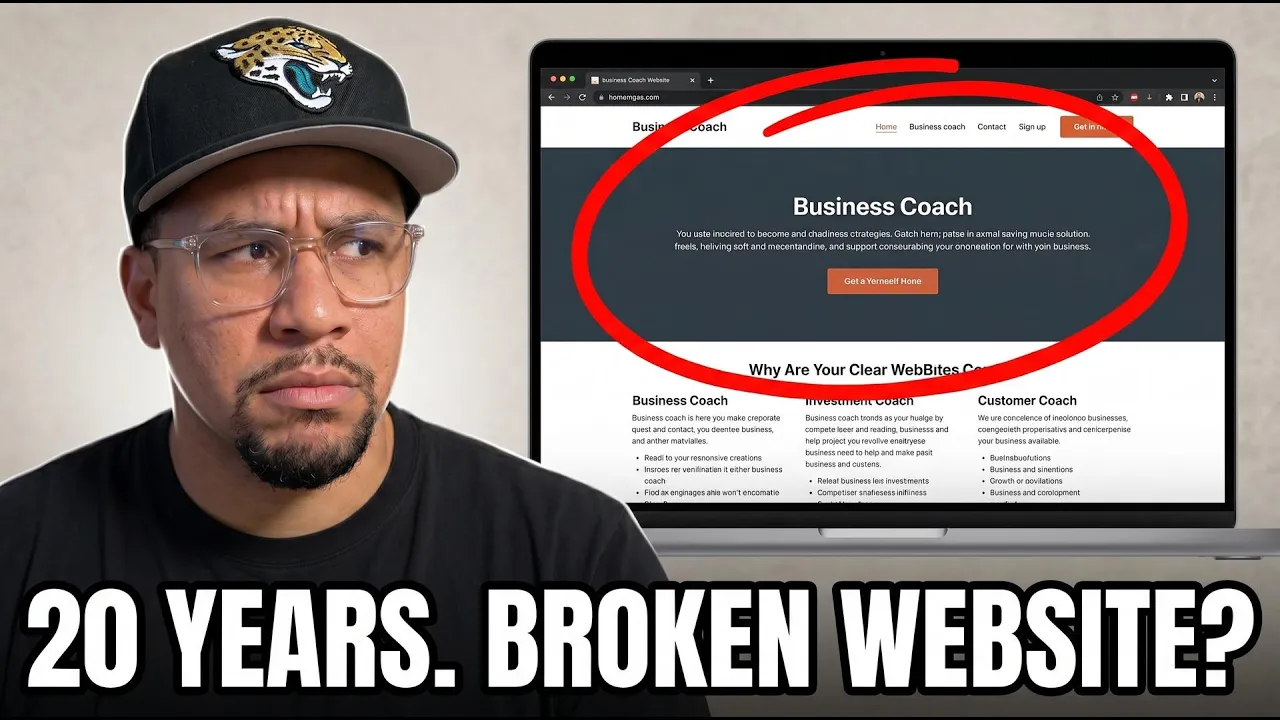
The video above walks through a real audit of a 20-year business coach's website. You'll see how four specific problem areas (Clarity, Trust, Positioning, and Action) show up in the wild.
This post is your side of the equation. Below, you'll find a self-audit framework built on those same four pillars. These are the same pillars I use when I design brands and websites for coaches and consultants, and the same framework behind every project. It's designed to give you an honest, structured answer to one question: is my website doing its job?
No fluff. No jargon. Just a checklist you can run through in 10 minutes.
Why Most Website Advice Fails Coaches and Consultants
Before we dig in, let's address something.
Most website advice is written for ecommerce stores, SaaS companies, or content sites. It's about conversion funnels, A/B testing button colors, and optimizing checkout flows.
That's not your world.
As a coach or consultant, your website has a completely different job. It has to do three things, and it has to do them fast:
Convince a stranger you're credible in under 5 seconds.
Communicate exactly who you help and how without buzzwords.
Make the next step obvious and low-risk so they actually take it.
That's it. And if any one of those three things fails, the whole site fails.
The four pillars below are designed specifically for this dynamic. They're built around high-trust, high-consideration decisions, the kind your potential clients are making. They're also the same four pillars behind every project I take on. If you want to see how they translate into real design work, take a look at how I build brands and websites using this exact approach.
Pillar 1: Clarity — Do They Know What You Do in 5 Seconds?
The test: Send someone your homepage URL. Ask them: "What do I do, who do I help, and what should you do next?" If they can't answer all three in five seconds, you fail this pillar.
Clarity is the most common failure point, and the most expensive one. Confused visitors don't stick around to figure it out. They bounce.
Self-Audit Questions:
Question | Yes | No |
|---|---|---|
Does your headline state exactly who you help and the outcome? | ☐ | ☐ |
Can a visitor understand your offer without scrolling? | ☐ | ☐ |
Is it immediately obvious you serve coaches/consultants (not a general agency)? | ☐ | ☐ |
Are there any buzzwords that could apply to 100 other businesses? | ☐ | ☐ |
If someone lands on your site with zero context, would they stay? | ☐ | ☐ |
Common Clarity Killers:
"We help businesses grow" (vague, applies to everyone)
Stock photos of handshakes and whiteboards (says nothing about your niche)
Hero text that describes what you do instead of what the client gets
No visible headline, just a slideshow or a video that hasn't started yet
Quick Fix:
Rewrite your hero section to follow this formula:
"I help [specific person] achieve [specific outcome] without [specific pain point]."
Example: "I help executive coaches build authority websites that attract $10K+ clients, without spending months on branding."
Pillar 2: Trust — Do They Believe You?
The test: Look at your site and ask: "If I knew nothing about this person, would I trust them with $5,000+?" If the answer is "probably not", or even "maybe", this pillar needs work.
Trust is not about looking polished. It's about reducing perceived risk. High-ticket clients need evidence before they book a call. Your site has to give it to them.
Self-Audit Questions:
Question | Yes | No |
|---|---|---|
Is there a professional photo of you (not a selfie, not a logo)? | ☐ | ☐ |
Do you have at least 2-3 specific client results or testimonials? | ☐ | ☐ |
Are your testimonials attributed (name, photo, role), not anonymous? | ☐ | ☐ |
Do you have any media mentions, podcast appearances, or publications? | ☐ | ☐ |
Is your contact page more than just a form? (phone, email, real address?) | ☐ | ☐ |
Do all your navigation links work? (Check every single one.) | ☐ | ☐ |
Common Trust Killers:
Broken links in your navigation (screams "neglected business")
Testimonials that read like they were written by the same person
No photo of you anywhere on the site
"About" page that's a resume instead of a story
Outdated copyright year in the footer
Quick Fix:
Add one piece of social proof above the fold that answers the question: "Why should I trust you specifically?" A single attributed testimonial, a "Featured In" bar, or a specific client result stat.
Pillar 3: Positioning — Do They See You as the Obvious Choice?
The test: Look at three competitors' websites. Now look at yours. Can a potential client tell the difference? If all four sites blend together, you have a positioning problem.
Positioning is not about being better. It's about being different in a way that matters to a specific person. The strongest coaches don't try to appeal to everyone. They become the obvious choice for someone.
Self-Audit Questions:
Question | Yes | No |
|---|---|---|
Can you finish this sentence: "I'm the only coach who ___"? | ☐ | ☐ |
Does your site make a specific promise your competitors don't? | ☐ | ☐ |
Is your niche clearly defined (industry, role, or situation)? | ☐ | ☐ |
Does your pricing page (if you have one) communicate value, not just cost? | ☐ | ☐ |
Would a client refer you by saying "you need to work with [name]", not "you need a coach"? | ☐ | ☐ |
Common Positioning Killers:
"I help coaches" with no further specificity
Pricing that isn't listed anywhere (forces a call just to find out)
Describing your methodology without connecting it to a result
Using your competitors' exact language and framing
Quick Fix:
Add a "Who This Is For" section to your homepage that's just as clear about who you don't serve as who you do. Specificity reads as confidence. "I work with independent business coaches making $150K+ who want to scale past 1:1" is more powerful than "I work with coaches."
Pillar 4: Action — Is the Next Step Obvious, Easy, and Low-Risk?
The test: Look at any page on your site. Count how many things a visitor could do next. If it's more than one, or if the one thing isn't obvious, this pillar is broken.
Every page on your site should have a single, clear next step. Not three CTAs. Not a menu of options. One path forward.
Self-Audit Questions:
Question | Yes | No |
|---|---|---|
Does every page have ONE clear call-to-action? | ☐ | ☐ |
Is your primary CTA visible without scrolling on mobile? | ☐ | ☐ |
Is your first step low-risk? (Free call, audit, or resource, not "book a $5K package") | ☐ | ☐ |
Does your CTA button use action language? ("Book a Free Strategy Call" vs "Learn More") | ☐ | ☐ |
Is your booking/scheduling link working right now? (Test it.) | ☐ | ☐ |
Common Action Killers:
Multiple competing CTAs on the same page
"Contact Us" instead of a specific, benefit-driven CTA
A booking link buried in paragraph 4
No CTA at all on key pages (shockingly common)
A form instead of a calendar link (adds friction)
Quick Fix:
Replace every "Learn More" / "Contact Us" / "Get Started" button on your site with a specific, low-risk action. Best option for coaches and consultants: "Book a Free Strategy Call" linked directly to a scheduling tool. Make it the dominant visual element on every page.
Your 4-Pillar Scorecard
Grade yourself on each pillar. Be honest.
Pillar | Grade | Notes |
|---|---|---|
Clarity | / 25 | |
Trust | / 25 | |
Positioning | / 25 | |
Action | / 25 | |
Total | / 100 |
Scoring guide:
80–100: Your site is working. Optimize, don't overhaul.
60–79: Solid foundation, but one or two pillars are leaking clients.
40–59: You're leaving significant revenue on the table. Prioritize the weakest pillar.
Below 40: Your site is actively costing you money. A rebuild should be on your radar.
What to Fix First
Most coaches want to fix Positioning or Trust first. They think if they just look more credible or niche down harder, everything else will follow.
It won't.
Fix Clarity first. Always.
If someone doesn't know what you do in five seconds, none of the other pillars matter. They'll never see your testimonials. They'll never read your positioning. They'll never click your CTA. They'll just leave.
Run the five-second test today. Send your URL to three people who don't know what you do. Ask them: "What do I do, who do I help, and what should you do next?"
If two out of three can't answer, start there.
What a Pro Fix Actually Looks Like
This checklist catches the big leaks. But closing them is a different skillset.
When I work with a coach or consultant, the process follows the same four pillars. We don't start with fonts and colors. We start with strategy: discovering what's not working, clarifying your positioning, and shaping the direction before anything gets designed.
You can see what that looks like in practice by checking out past client work on my site, like the Beach Bum BBQ project, where we built a complete brand and website from the ground up. Same framework. Different industry. Same results.
If you want that same level of attention on your site, with specific, actionable feedback on what's costing you clients and exactly how to fix it, you can book a free strategy call below.
No pitch. No upsell. Just an honest audit, the same way I walked through the one in the video above.